
Most organizations do not have a workforce data problem anymore.
They have a prioritization problem.
HR teams today can track almost everything: sourcing channels, recruiter activity, engagement scores, interview ratios, attrition patterns, compensation benchmarks, performance curves. Yet despite this explosion of visibility, many leadership teams still struggle to answer a basic business question:
“Which people decisions are actually improving business performance?”
That gap exists because workforce analytics has become heavily focused on measurement volume instead of decision quality.
The organizations creating real strategic advantage are not the ones collecting the most data. They are the ones disciplined enough to ask sharper questions before selecting what deserves measurement in the first place.
The Hidden Cost of KPI Inflation
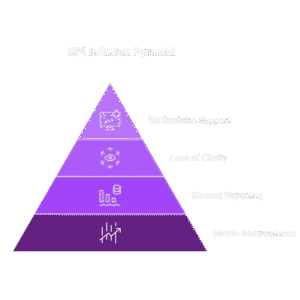
Over time, many HR functions accumulate metrics the same way enterprises accumulate software subscriptions: gradually, defensively, and without elimination.
Every leadership request creates another dashboard. Every hiring issue introduces another tracking layer. Eventually, reporting structures become bloated with operational indicators that consume attention but contribute little strategic clarity.
This creates KPI inflation.
When every metric is treated as important, executives lose visibility into what actually moves the business.
For example, recruitment teams frequently report:
- Number of applications received
- Recruiter outreach activity
- Interview completion rates
- Offer acceptance percentages
These metrics explain process movement. They do not explain business outcomes.
A leadership team does not benefit from knowing that applications increased by 40% if revenue-critical roles remain unfilled for months. Similarly, a strong acceptance rate becomes irrelevant if new hires fail to improve execution quality six months later.
The purpose of workforce analytics is not operational storytelling. It is commercial decision support.
That requires a far smaller set of metrics tied directly to organizational priorities.
Strong Workforce Analytics Begins Before Data Collection
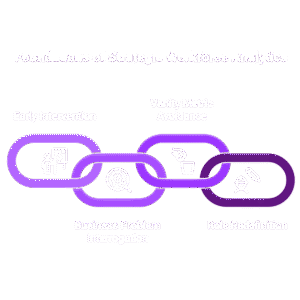
Most HR reporting starts too late in the decision cycle.
By the time analytics discussions begin, the organization has already accepted assumptions about hiring needs, team structures, or capability gaps without scrutiny.
Strategic workforce analytics starts earlier.
Before defining KPIs, HR leaders should interrogate the business problem itself:
- Is hiring volume increasing because of growth or because retention is collapsing?
- Is a department understaffed, or is poor process design creating dependency on headcount expansion?
- Is leadership requesting “top talent,” or are role expectations fundamentally unrealistic for the market?
Without these questions, organizations risk measuring symptoms instead of causes.
This is where vanity metrics quietly distort hiring strategy. Companies begin optimizing recruiter speed, application volume, or interview efficiency while ignoring whether the role itself is commercially justified.
In many cases, the smartest hiring decision is not faster recruitment. It is redefining the business problem before opening the role.
The Most Valuable Hiring Data Rarely Comes from Dashboards
One of the biggest weaknesses in hiring analytics is over-reliance on internal reporting while underinvesting in diagnostic conversations.
The quality of hiring outcomes depends heavily on the quality of questions asked across three levels.
Questions for Business Leaders.

Most hiring failures begin with vague commercial objectives.
If leadership cannot clearly define what business outcome a role should influence, recruitment becomes reactive from the start.
Instead of asking:
“Can we hire this role quickly?”
HR should ask:
- What revenue, delivery, or operational problem does this hire solve?
- What changes if this position remains vacant for another six months?
- Is this role creating future capability or compensating for structural inefficiency?
These questions force alignment between workforce investment and enterprise priorities.
Questions for Hiring Managers.
Many hiring managers describe candidates through generic preferences:
- “Strong communicator”
- “Culture fit”
- “Ownership mindset”
None of these define measurable success.
Stronger hiring conversations focus on execution realities:
- What decisions will this person make independently?
- Which stakeholders will create friction in this role?
- What separates average performance from exceptional performance here?
This shifts hiring from personality matching to business impact evaluation.
Questions for Candidates.
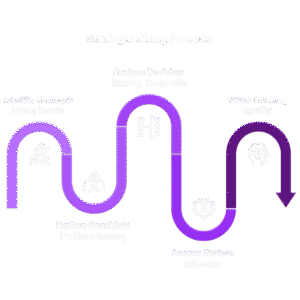
Most interviews still prioritize rehearsed competency validation instead of operational insight.
Strategic hiring teams increasingly explore:
- How candidates diagnose unfamiliar problems
- How they prioritize under ambiguity
- What trade-offs they make during constrained decision-making
- How they influence systems, not just tasks
Because modern hiring value lies less in polished answers and more in thinking quality under complexity.
Simplification Is Becoming an Executive Advantage
The future of workforce analytics will likely belong to organizations that measure less but connect metrics more intelligently to business outcomes.
Instead of twenty disconnected hiring indicators, leadership teams need a small number of strategically linked signals:
- Quality of hires tied to business performance
- Retention trends connected to management effectiveness
- Workforce planning aligned with growth forecasts
- Hiring investments measured against long-term capability creation
Simplification does not reduce analytical sophistication.
It increases it.
Because the strongest HR functions are no longer trying to prove activity. They are trying to improve decision precision.
And that only happens when organizations stop asking, “What else can we measure?” and start asking, “What problem are we actually trying to solve?”