
Here’s a scene you’ve probably lived through. A project misses its deadline. Leadership calls a meeting to “understand what happened.” Five people show up. Every single one of them has a reasonable explanation for why it wasn’t their fault. The engineer blames unclear requirements. The PM blames the client for changing scope. The designer blames the engineer for not flagging technical constraints earlier. And somehow, after an hour of talking, you leave that room with more clarity on everyone’s feelings and zero clarity on who’s actually going to fix it.
This isn’t a people problem. It’s a structural one. And it’s worth understanding why, because most companies try to solve it with the wrong tools.
The 10-Person Company Doesn’t Have This Problem — And That’s the Clue
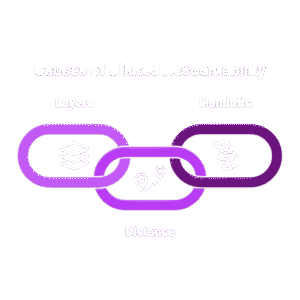
When a company is small, accountability is basically automatic. If something breaks, everyone in the room already knows who touched it last. There’s no ambiguity because there’s no distance between the decision and the person who made it. You don’t need a system. You just need eyes.
The moment a company crosses into “layers” — managers of managers, cross-functional pods, matrixed reporting lines — that automatic clarity disappears. Not because people got lazier or less honest, but because that distance grew. By the time a bad outcome shows up, it’s traveled through four handoffs, two approvals, and a Slack thread nobody fully read. Untangling who owned what at each step becomes genuinely hard, not just inconvenient.
This is the part most leadership advice skips. They treat diluted accountability as a character flaw — people “not stepping up” — when it’s actually a design flaw in how work gets structured.
The Real Culprit: Shared Ownership Isn’t Ownership
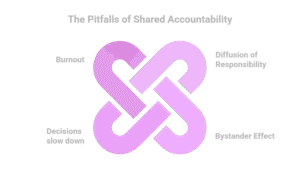
Companies love saying “we’re all accountable for this.” It sounds inclusive. It’s also functionally useless.
When five people are accountable for one outcome, you don’t get five times the responsibility — you get a fifth of it, distributed so thin that no individual feels the weight of failure. It’s the same dynamic as a shared apartment where nobody’s assigned to take the trash out: everyone assumes someone else will notice first, so the bin overflows before anyone actually moves. Scale that up to a product launch or a client account, and the “bin overflowing” version costs a lot more than a bad smell in the kitchen.
The fix isn’t “care more.” It’s naming exactly one person who owns the outcome — not the task, the outcome — even if six people are doing the work. One person whose name is attached to whether it succeeds or fails. Everyone else supports. That person decides.
This feels uncomfortable at first because it looks like you’re setting someone up to take blame alone. But the opposite happens in practice: people who are individually accountable ask better questions earlier, escalate faster, and stop assuming someone else has it handled. Ambiguity, not individual ownership, is what actually burns people out.
A RACI Chart Only Works If You Do the Hard Part First
RACI charts — Responsible, Accountable, Consulted, Informed — get a bad reputation, but the tool isn’t the problem. Teams that actually keep theirs alive, revisit it every time a project scope shifts, and treat it as a living reference get real value from it: fewer “wait, I thought you were doing that” moments, faster escalation, less duplicated work.
Where it falls apart is sequencing. Most companies build the org chart first, hand out titles, and then fill in a RACI chart to match, which means the “Accountable” column often gets assigned to whoever has the right seniority, not whoever actually has the authority to influence the outcome. The chart looks complete. It just doesn’t reflect reality.
The fix isn’t ditching RACI, it’s flipping the order: before you fill in who’s Accountable for something, check whether that person can actually pull the levers that affect it. If someone is “accountable” for a metric they have no authority to influence — say, a support lead accountable for churn but with no real say in the product roadmap — the chart will say accountability exists, but it won’t function. You’ve documented a scapegoat, not an owner. This happens constantly in growing companies, and it’s one of the quiet reasons good people quit: they’re on the hook for outcomes they structurally cannot control.
The Meeting Cadence Trick Nobody Talks About
Here’s something practical that rarely makes it into leadership content: accountability doesn’t erode in big dramatic moments. It erodes in the small gap between when a problem becomes visible and when someone is forced to say something about it out loud.
The single highest-leverage fix isn’t a new tool or a new value statement. It’s shrinking that gap. A weekly async update where each owner writes two lines “here’s where this stands, here’s what’s blocking it”, does more for accountability than a quarterly all-hands ever will. Not because the update itself matters, but because writing it forces the owner to confront reality on a fixed schedule instead of when it’s convenient to.
Public visibility, even low-stakes public visibility, changes behavior. Nobody wants to write “still stuck, same reason as last week” three weeks running. That mild social pressure does more work than any performance review.